Sewage pumping stations
Sewage pumping stations (SPS) are used as part of treatment facilities when the terrain does not allow wastewater to be discharged by gravity. The use of SPS allows avoiding the need to bury collectors too deep. The choice of SPS is determined by the following parameters:
Depth of the inlet collector;
Volume of wastewater entering the pumping station;
Type of liquid being pumped;
Hydrogeological conditions of construction;
Type of pumping units and their control method.
ECOMAX SPS are used for pumping industrial, domestic and storm (atmospheric) wastewater, chemically aggressive and oil-containing effluents, as well as purified ones.
ECOMAX pumping station bodies are made of composite materials and have increased tightness, wear resistance and durability. At the customer's request, pumping stations are equipped with special equipment and structures (pumps, control cabinets, ladders, grates, service platforms, pipelines, etc.) according to the provided technical specifications
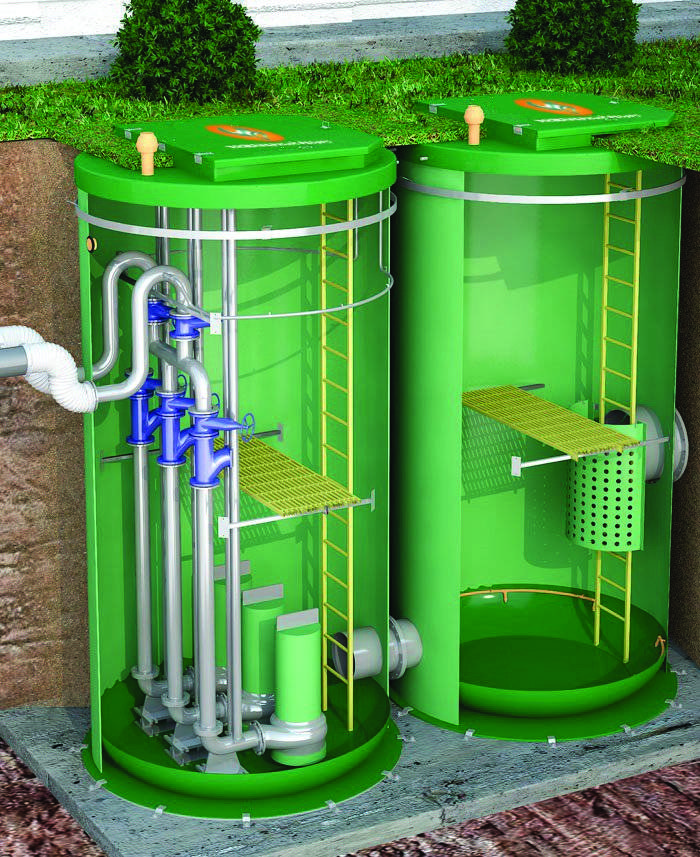
Main parameters:
- The capacity of the pumping stations is from 1 to 1,000 m3/hour
- (1,000-10,000 m3/hour in a special design) with a head of up to 100 m;
- (1,000-10,000 m3/hour in a special design) with a head of up to 100 m;
- The temperature of the pumped liquids is in the range from +5°C to +60°;
- Primarily, pumping stations are manufactured with a height of 5 m and body diameters of: 1.0 m; 1.1 m; 1.2 m; 1.4 m; 1.5 m; 1.8 m; 2.0 m; 2.3 m; 2.5 m; 3.0 m; 3.2 m; 3.6 m;
- When manufacturing housings with a diameter from 6 to 30 m, production is organized at the construction site and subsequent operation;
- The capacity of the manufactured pumping stations is 1–1000 m3/hour (1000–10000 m3/hour in a special design) with a head of up to 100 m;
- The degree of protection of the control cabinet casings is not lower than IP55 according to GOST 14254;
- The temperature of the pumped liquids must be between +5°C and +60°C. Our production capacities allow us to manufacture pumping stations of various sizes, using standard and customized solutions, starting from the product design stage.
Main advantages:
- Various types of execution: with submersible pumps, dry execution or in several housings;
- Housings made of composite materials based on fiberglass - are strong, lightweight and durable;
Types of pumping stations
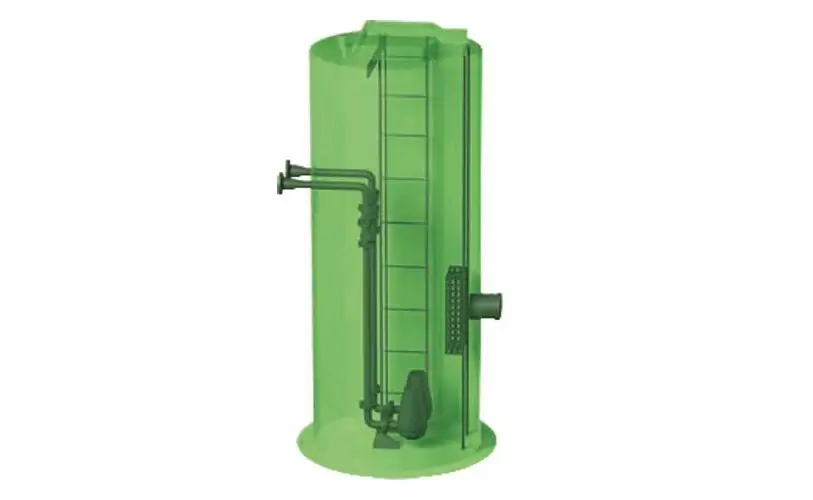
with submersible pumps
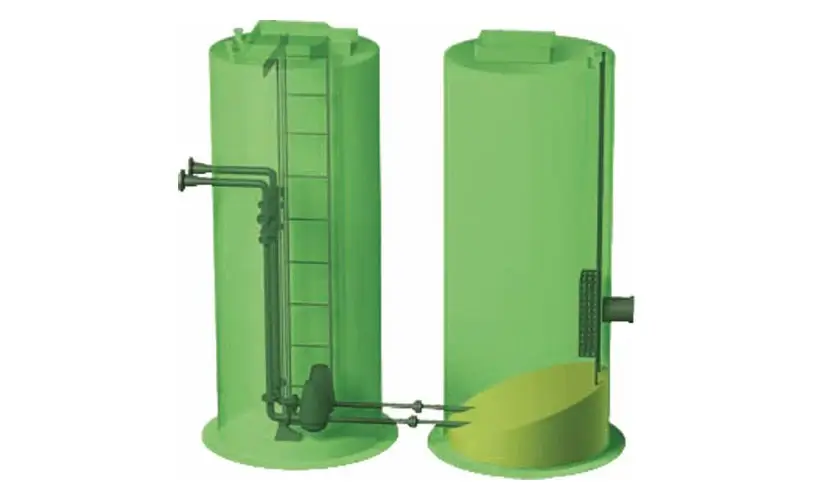
dry execution
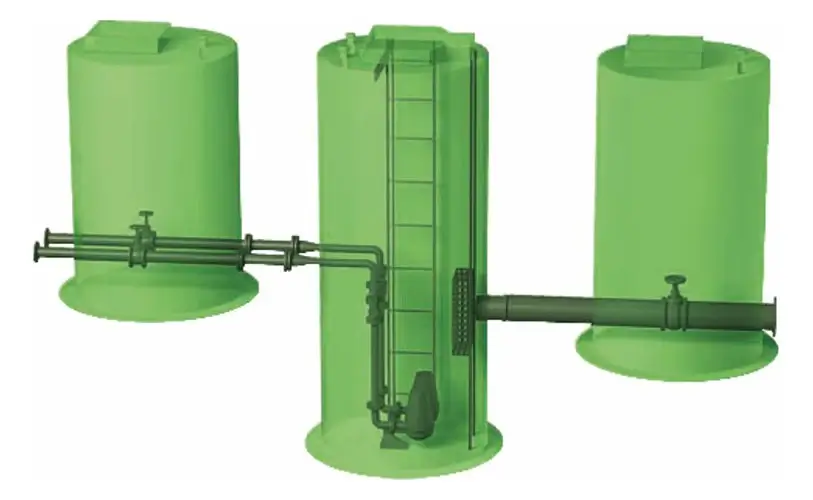
in several buildings
Example of a wastewater treatment scheme with a reactor
The pumping station pumps liquids using 2 pumps - the main and backup. The pumped liquid enters the pumping station through a gravity collector and an inlet pipe. When a certain liquid level is reached in the pumping station, the level sensors are triggered
Standard design control cabinet operating principle
The control cabinet monitors the liquid level and controls the pump activation using float switches. Four float switches must be connected to the control cabinet:
- the first level float switch signals the minimum operating liquid level and switches off both pumps;
- the second level float switch signals the upper operating liquid level and switches on one of the pumps in accordance with the activation sequence;
- the third level float switch signals the peak operating liquid level and switches on both pumps simultaneously;
- the fourth level float switch signals the maximum permissible liquid level (threat of flooding) and switches on the "MAX LEVEL" indicator and an external emergency indicator.
Manual operation mode of the SHU
In manual operation mode, one or two pumps will be switched on until the float switch reaches the minimum possible liquid level. If only one of the pumps operates in manual mode, and the other is in automatic mode, the latter is switched on in parallel operation mode if the upper maximum permissible liquid level is exceeded.
Automatic operation mode of the SHU
When the liquid level rises, the float switch of the upper working level closes and, in accordance with the shift mode of operation, the next pump in the sequence is switched on. When the liquid level drops to the minimum, the pump is switched off. When the liquid level rises again and the contacts of the float switch of the upper level close, the next pump in the sequence is switched on to ensure the shift mode of operation. When the float switch of the peak working liquid level closes, the second pump is switched on. Protection against overload of the pump electric motors is provided by protection machines located in the SHU, protection against overheating of the electric motors is provided by built-in thermal relays. When the protection machine or thermal relay is triggered, the corresponding electric motor is switched off and the emergency alarm is activated.
The SHU ensures the activation of the emergency signal when the liquid level relay is triggered, which is used to monitor the presence of liquid in the lubrication system. This function is only effective if there is a sensor built into the electric motor. The emergency mode is reset by pressing the "RESET" button. When connecting a signaling device (light, sound) to the relay contact, it is possible to remotely monitor the state of the control unit. This relay contact closes in t
Installation of a Sewage pumping stations
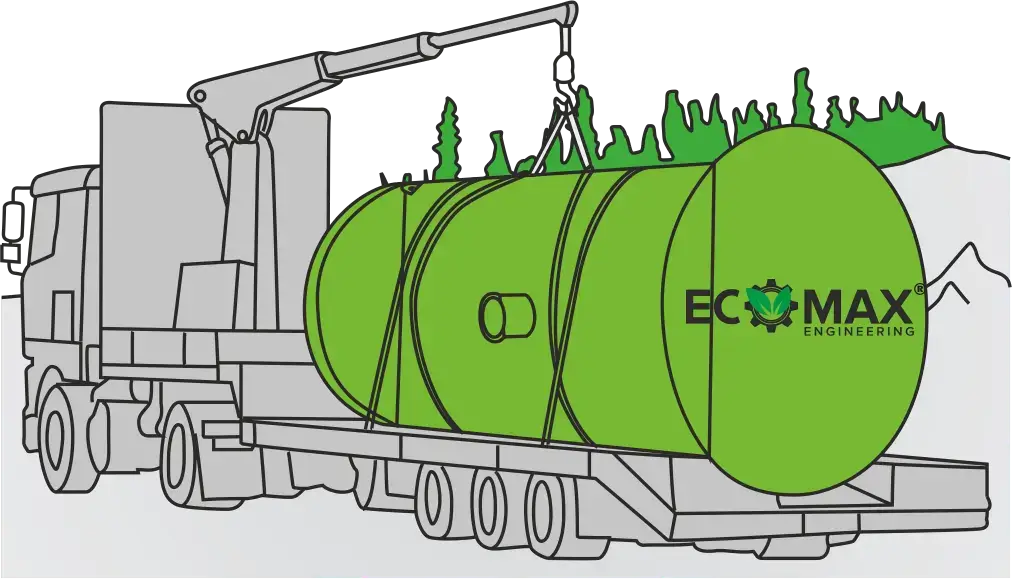
The KNS is transported in a horizontal position. The KNS must be securely fastened to avoid mechanical damage. The carrier and the person responsible for the transportation are responsible for the transportation.

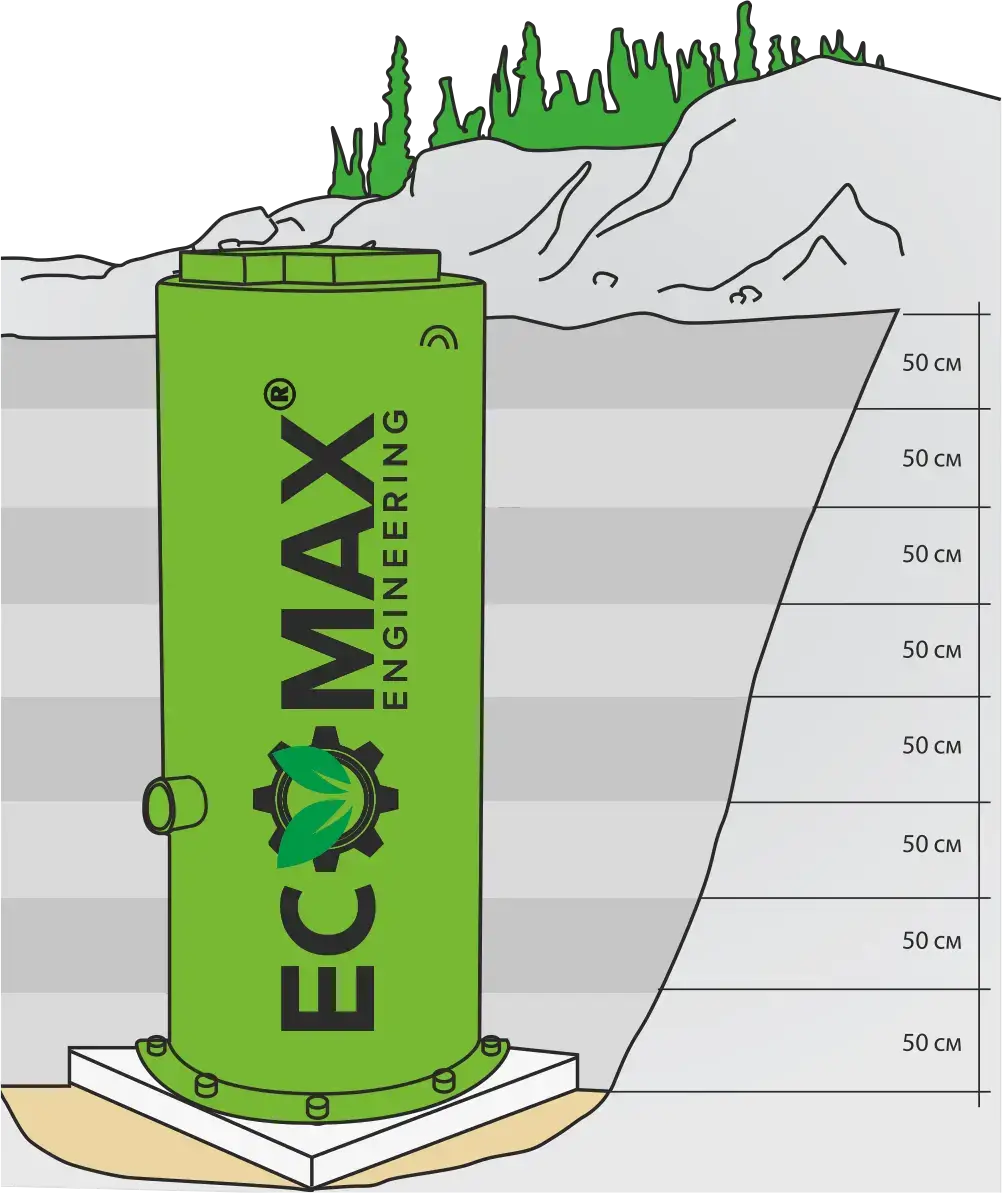
- earthworks — a pit with a depth of NKNS- 0.20 + 0.10 + hplate, in meters;
- sand preparation 10 cm thick;
- the third-level float switch signals the peak operating level of the liquid and turns on both pumps simultaneously;
- placing the support plate on the bottom of the pit.
- The support plate must be installed strictly horizontally.
The KNS is installed using a crane with the appropriate lifting capacity (KNS weight - see table). For fastening, mounting lugs are provided on the KNS body from the outside. The KNS movement by crane must be carried out in compliance with safety regulations. During installation, impact loads on the pumping station housing are not allowed, as this may lead to deformation and, as a consequence, to a breach of the seal of the housing and improper operation of the pumping station.
The pumping station is installed on the support plate strictly vertically. In the plan, the pumping station must be installed in the center of the concrete pad, turning the pumping station so that the directions of the pressure and inlet pipes coincide with the pressure and inlet pipelines, respectively.
The pumping station is attached to the reinforced concrete support plate with anchor bolts. The inlet and outlet pipes must be joined to the corresponding pipelines using flange connections in dry wells, after which it is necessary to check the tightness of the joint. Submersible pumping units are installed by lowering them along the guides until the lock is triggered.
The cabinet with the control panel is mounted:
- for outdoor installation — in close proximity to the pumping station;
- for indoor installation — in the room agreed with the customer. In this case, the laying of cables to the room is agreed upon additionally.
Electrical installation work is performed in accordance with SNiP 3-05.06-85 and the installation and assembly manual for a specific pumping unit and control panel. Upon completion of installation, a test run of the pumping station is carried out.
The pumping station must be backfilled:- manually up to ½ the height of the pumping station with layer-by-layer compaction;
- mechanically with layer-by-layer compaction (50 cm).
The presence of solid inclusions (boulders, bricks, etc.) is not allowed to avoid impact effects. The pumping station cover with special fasteners that prevent unauthorized access protrudes from the surface by 100 mm (in the standard version).
KNS sewage pumping stations ECOMAX have the following range of advantages:
Get the optimal solution
The choice of installation depends on the area of application, quality and consumption of water. We are at your service to find the optimal solution based on our know-how. Fill out the form and we will contact you.