Softening units for hardness removal
Softening units are used to reduce the calcium and magnesium content in water using a cation exchanger. Calcium and magnesium are exchanged for sodium by ion exchange.
Softened water is used in steam boilers, district heating units, laundries, cooling towers, in rinsing, washing, dishwashing processes, etc.
Why softening?
Softening prevents calcium deposits in pipelines, steam boilers, district heating systems, water heaters, heat exchangers and cooling towers. The traditional use of chemical reagents to bind calcium can be avoided. In other words, softening can optimize the energy use of boilers and hot water plants, minimize the use of chemical reagents and extend the life of plants and stations.

Application of water softening systems

Water softening before reverse osmosis
The formation of hardness salt deposits can damage the membranes in the reverse osmosis unit. Installing a softener before the reverse osmosis unit will extend the life of the unit and ensure reliability in operation.

Drinking Water Softening
Groundwater can contain large amounts of calcium and magnesium. Water supply companies may benefit from water softening to prevent the formation of hardness salt deposits in piping and plumbing systems.

Softened Process Water
Softening the water used for rinsing, cleaning, cooling, etc. is a valuable investment to avoid the problems that hard water can cause in equipment. And it can also be an environmentally friendly solution. For example, in commercial laundries, where soft water allows for lower wash temperatures and thus reduced detergent use.
Product overview
Our product range includes a large number of standard plants, designed and manufactured in-house. The starting point is our standard modular system, which offers high flexibility, high operational reliability and short delivery times. Each solution can be customized and built to suit the specific application by adapting the choice of materials, measuring and control systems - based on our combined know-how.
Plant design
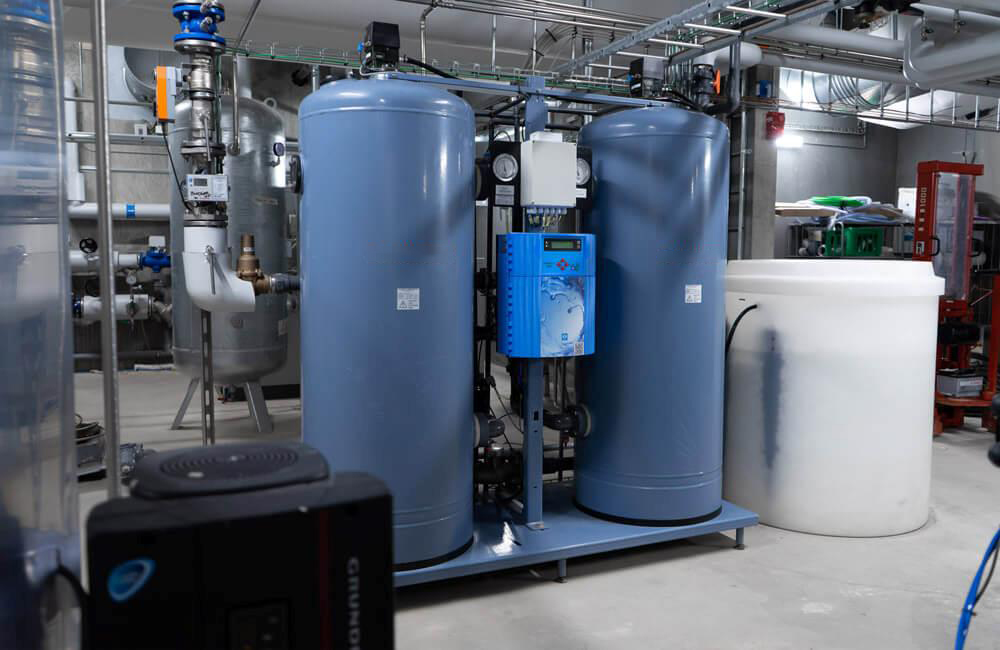
The standard plants are available with either one or two tanks for continuous water production. Each tank has individual valves to ensure reliable operation. All plant types are supplied with a brine tank.
Several plant types are available for treating both cold (max. 35°C) and hot water (max. 85°C). The hot water softening plants are particularly suitable for sanitary systems.
Contact your local sales and service office for further information, data sheets or instructions.

Productivity 3.6 m3/h
| Type: | SM / SG |
| Temperature: | Холодная и горячая |
| Pipelines: | PVC or galvanized steel |

Productivity 9 m3/h
| Type: | SF / SFG |
| Temperature: | Cold or hot |
| Pipelines: | PVC or galvanized steel |

Productivity 30 m3/h
| Type: | SMH / SMP |
| Temperature: | Cold |
|
Pipe system: |
PVC or PP |

Productivity 32 m3/h
| Type: | SFH / SFHG |
| Temperature: | Cold or hot |
| Pipelines: | PVC or galvanized steel |

Capacity 150 m3/h
Type: STFA
Temperature: Cold
Piping: PVC or PP
STFA softeners are supplied with a nozzle plate as standard. This ensures optimum use of salt and uniform water distribution both during operation and backwash. All STFA systems are also equipped with a brine tank for automatic brine production.
Designed for maximum reliability
The SMP softener is specially designed for applications that require high reliability. The design of the unit and piping system results in low pressure losses and, as a result, lower energy consumption.
The units are equipped with automatic pneumatically operated ball valves - in the absence of electricity and air, the automatic valves close.
Download the brochure to learn more about the features of the SMP softener.

Anti-corrosion housings
The filter housing is made of steel and is therefore less sensitive to pressure drops, vacuum and mechanical shocks. The housing is covered with polyethylene. Thus, the filter housings combine the strength of steel with the strong anti-corrosion properties of synthetic material.

Trouble-free 5-way valve
Our patented 5-way valve is made from high-quality synthetic material and has a small number of moving parts. Together, this ensures the valve operates reliably, has a long service life and requires minimal maintenance.

Piping System
The standard piping system is made of PVC or PP, which are resistant to corrosion and chemicals. The piping system can also be made of several other types of plastic or stainless steel. Steel is a durable material that can withstand very high temperatures.

Standard Control
Each softener is equipped with a standard PLC control. Our controls are specially designed and individually programmed by our engineers. The simple user interface makes it easy to check parameters, monitor operation and regeneration.

Individual
Triplex softening system
A special design offers three-tank systems with at least two tanks in operation at all times. Each tank has individual valves to ensure reliable operation. The picture shows a triplex softening system in a Danish waterworks, where the water hardness is reduced from 30odH to 0.5odH and then mixed with feed water to 9odH.

Options - for reliable production
Brine Plant
Salt brine plant is an automatic system for producing large quantities of salt brine. Usually, less salt is used. At the same time, inexpensive salt can be used. You can select a brine plant for several series of plants.

Automatic quality test
The quality of softened water can be monitored using the Testomat device, which analyzes the residual water hardness. The Testomat device is set to the actual hardness limit. Exceeding this limit will trigger an alarm and start regeneration.

Manual Test Kit
Softened water monitoring can also be done manually with our Durognost Test Kit. A simple and quick solution for checking residual hardness after softening.

Water Softening Salt Tablets
The quality of the salt used for regeneration can affect the performance of your softener. ECOMAX salt is manufactured under controlled production conditions and tested in our own facilities. Our product is approved for use in the food industry and typically contains 99.8% sodium chloride (min. 99%).
10 kg
Plastic bag with handle
 >
25 kg
Plastic bag

1000 kg
Pallet with 40 bags

Reference
Water Saving
Some softeners are equipped with conductivity meters, which continuously measure the actual conductivity of the backwash water. When the ion exchanger is clean, regeneration stops, thereby minimizing the consumption of backwash water.
Odense University Hospital is one of the largest hospitals in Denmark. The hospital chose a softener with a conductivity meter to minimize operating costs and water consumption.

Get the optimal solution
The choice of installation depends on the area of application, quality and consumption of water. We are at your service to find the optimal solution based on our know-how. Fill out the form and we will contact you.